

The world is becoming increasingly interconnected, and the concept of "home" is no longer limited to one country. Entrepreneurs expand businesses across continents, remote professionals work from anywhere with a reliable internet connection, investors diversify their assets internationally, and families seek better education, healthcare, and lifestyle opportunities abroad. As borders become more accessible through modern immigration programs, global mobility has emerged as one of the most important strategies for achieving long-term personal and financial freedom.
Today, relocating internationally is no longer reserved for multinational executives or ultra-high-net-worth individuals. Governments around the world actively compete to attract investors, entrepreneurs, skilled professionals, and remote workers by offering legal pathways that make living abroad more accessible than ever before. These pathways include Residency by Investment (RBI), Citizenship by Investment (CBI), and Digital Nomad Visa programs—each designed to meet different goals and lifestyles.
Choosing the right program, however, requires more than comparing investment amounts or processing times. Every immigration pathway comes with unique legal requirements, residency obligations, tax implications, family inclusion rules, and long-term benefits. Understanding these differences is essential before making a life-changing decision.
This guide has been created to help you navigate the modern global mobility landscape with confidence. Whether your objective is expanding your business internationally, securing a second residency, obtaining an additional passport, or embracing a location-independent lifestyle, you'll gain a clear understanding of the options available, the advantages each pathway offers, and the key factors to consider before choosing the program that best aligns with your goals.
KEY TAKEAWAYS
Quick Summary
Understand what Global Mobility means and why it has become increasingly important in today's interconnected world.
Learn the differences between Residency by Investment, Citizenship by Investment, and Digital Nomad Visa programs.
Discover which immigration pathway best aligns with your financial goals, lifestyle, family plans, and business ambitions.
Explore the key factors that should influence your decision, including investment requirements, residency obligations, taxation, processing timelines, and citizenship opportunities.
Compare the advantages and limitations of each global mobility pathway before making an informed decision.
Learn how Zenvify helps simplify your journey through country comparisons, personalized immigration roadmaps, and expert guidance.
WHAT IS GLOBAL MOBILITY?
Global mobility is the legal movement of individuals across international borders for purposes such as residence, employment, business expansion, investment, education, retirement, or lifestyle enhancement. It encompasses the immigration programs, legal frameworks, and residency opportunities that allow people to establish a long-term presence in another country while complying with local immigration laws.
Although the term originated in corporate relocation—where multinational companies transferred employees between offices—it has evolved significantly over the past decade. Today, global mobility extends far beyond corporate assignments and includes entrepreneurs launching international ventures, investors seeking diversified residency options, remote professionals embracing location-independent careers, retirees pursuing a higher quality of life, and families looking for greater security and opportunity.
Unlike traditional immigration, which often involves permanent relocation through employment or family sponsorship, modern global mobility offers a wider range of flexible pathways. Individuals can choose programs that align with their personal objectives, whether they wish to gain legal residency through investment, obtain a second citizenship, work remotely under a Digital Nomad Visa, or establish a presence in a country without immediately seeking permanent settlement.
Global mobility is ultimately about creating freedom of choice. It allows individuals to build lives that are not restricted by a single jurisdiction, offering greater flexibility in where they live, work, invest, educate their children, and plan for the future.
The Three Main Global Mobility Pathways
Modern global mobility is built around three primary immigration pathways. While each option allows individuals to establish a legal presence in another country, they differ significantly in terms of eligibility, investment requirements, rights, obligations, and long-term outcomes.
Understanding these differences is essential before choosing a program that aligns with your financial goals, family plans, business ambitions, and preferred lifestyle.
The three most common pathways are:
Let's explore each option in detail.
Residency by Investment (RBI)
What Is Residency by Investment?
Residency by Investment (RBI), often referred to as a Golden Visa, allows eligible foreign nationals to obtain legal residency in a country by making a qualifying investment. Depending on the program, the investment may involve real estate, government-approved funds, business investments, job creation, or other approved economic contributions.
Unlike Citizenship by Investment, Residency by Investment does not immediately grant citizenship. Instead, applicants receive temporary or permanent residency status, which may eventually lead to permanent residence or naturalization if they continue to meet the country's legal requirements.
Many investors choose this pathway because it offers greater flexibilit y, lower investment thresholds in some jurisdictions, and the opportunity to establish a long-term presence without giving up their original nationality.
Why Governments Offer Residency by Investment
Residency by Investment programs are designed to attract foreign capital, encourage economic development, stimulate real estate markets, create employment opportunities, and strengthen international investment.
Governments benefit by attracting financially stable individuals who contribute to the local economy, while applicants gain access to legal residency and the associated lifestyle and business advantages.
Key Benefits of Residency by Investment
Depending on the country, Residency by Investment programs may offer:
Legal residency in a stable and secure country.
Visa-free travel within regional agreements (such as the Schengen Area, where applicable).
The ability to include eligible family members.
Access to education and healthcare systems.
Opportunities to establish businesses and open bank accounts.
A potential pathway toward permanent residency and citizenship.
Greater international mobility.
Long-term asset diversification.
Many programs also have minimal physical presence requirements, allowing investors to maintain their existing lifestyle while preserving future options.
Residency by Investment is often the preferred choice for investors who want flexibility rather than immediate citizenship. It provides access to a new jurisdiction while allowing time to evaluate long-term relocation plans before committing to naturalization.
Who Is Residency by Investment Best For?
Residency by Investment is well suited for:
Entrepreneurs expanding internationally.
Investors seeking European access.
Families prioritizing education and healthcare.
Retirees looking for lifestyle improvements.
Individuals planning eventual citizenship.
Business owners requiring international mobility.
People seeking greater financial diversification.
Common Investment Options
Although requirements vary between countries, common qualifying investments include:
Government-approved real estate purchases.
Investment funds.
Business investments.
Venture capital investments.
Job creation initiatives.
Economic contribution schemes.
Public development projects.
Typical Timeline
Application Submission
↓
Due Diligence
↓
Investment Completion
↓
Residence Permit Issued
↓
Permit Renewals
↓
Permanent Residence (where applicable)
↓
Citizenship through Naturalization (subject to eligibility)
Popular Residency by Investment Destinations
Some of the most recognized Residency by Investment destinations include:
Each country offers different investment requirements, residency obligations, taxation policies, and citizenship pathways, making careful comparison essential.
Citizenship by Investment (CBI)
What Is Citizenship by Investment?
Citizenship by Investment (CBI) enables eligible individuals to obtain citizenship in a country by making a qualifying economic contribution, subject to the country's legal framework and due diligence procedures.
Unlike Residency by Investment, successful applicants generally receive citizenship and a passport once their application is approved, provided all legal requirements are satisfied.
These programs are designed to attract foreign investment while providing applicants with increased travel freedom, expanded business opportunities, and greater international flexibility.
Why Investors Choose Citizenship by Investment
Citizenship by Investment is attractive because it can provide:
A second passport.
Expanded visa-free travel.
Greater international business flexibility.
Enhanced family security.
Long-term diversification.
Access to additional banking and investment opportunities.
An alternative citizenship for future planning.
For many applicants, the value lies not only in travel benefits but also in creating additional options for future generations.
Key Benefits
Depending on the jurisdiction, Citizenship by Investment may offer:
Immediate or relatively fast citizenship.
Visa-free or visa-on-arrival travel to numerous destinations.
Citizenship rights for qualifying family members.
No requirement to renounce existing citizenship (where dual citizenship is permitted).
The right to live, work, or invest according to the country's laws.
Long-term succession planning.
A second citizenship should be viewed as a long-term strategic asset rather than simply a travel document. Before applying, investors should consider taxation, family succession, residency obligations, and future lifestyle goals—not just visa-free travel.
Who Is Citizenship by Investment Best For?
Citizenship by Investment is commonly chosen by:
Global entrepreneurs.
High-net-worth individuals.
International investors.
Families seeking long-term security.
Frequent international travelers.
Individuals looking to diversify their global footprint.
Typical Investment Options
Programs may include:
Government fund contributions.
Approved real estate investments.
Business investments.
National development funds.
Public infrastructure contributions.
The available options depend on each country's legislation.
Popular Citizenship by Investment Countries
Well-known Citizenship by Investment jurisdictions include:
Each program has distinct investment thresholds, processing timelines, and legal requirements.
Digital Nomad Visas (DNV)
What Is a Digital Nomad Visa?
A Digital Nomad Visa allows remote employees, freelancers, entrepreneurs, and online business owners to legally live in another country while continuing to earn income from employers or clients located outside the host country.
Unlike traditional work permits, Digital Nomad Visas are designed specifically for location-independent professionals whose economic activity takes place internationally rather than within the local labor market.
This category has expanded rapidly as remote work has become a permanent feature of the global economy.
Why Digital Nomad Visas Have Become So Popular
Remote work has fundamentally changed where people choose to live.
Instead of being tied to an office, professionals increasingly prioritize:
Quality of life.
Lower living costs.
Better climate.
Reliable internet.
International travel.
Safety.
Access to vibrant business communities.
Governments benefit by attracting skilled professionals who contribute to local economies without competing directly for domestic jobs.
Key Benefits
Digital Nomad Visas often provide:
Legal residence while working remotely.
Longer stays than tourist visas.
Access to local accommodation and services.
Greater immigration certainty.
Opportunities to experience new cultures.
Potential renewal options.
Family inclusion in some jurisdictions.
Who Is It Best For?
Digital Nomad Visas are particularly suitable for:
Remote employees.
Freelancers.
Consultants.
Online business owners.
Software developers.
Designers.
Digital marketers.
Writers.
Content creators.
Independent professionals.
Common Eligibility Requirements
Most countries require applicants to demonstrate:
Remote employment or self-employment.
Stable foreign income.
Minimum monthly income thresholds.
Health insurance coverage.
Clean criminal record.
Valid passport.
Specific requirements differ by jurisdiction.
Popular Digital Nomad Destinations
Leading destinations include:
These countries are popular due to their infrastructure, lifestyle, connectivity, and dedicated remote work programs.
Comparing the Three Global Mobility Pathways
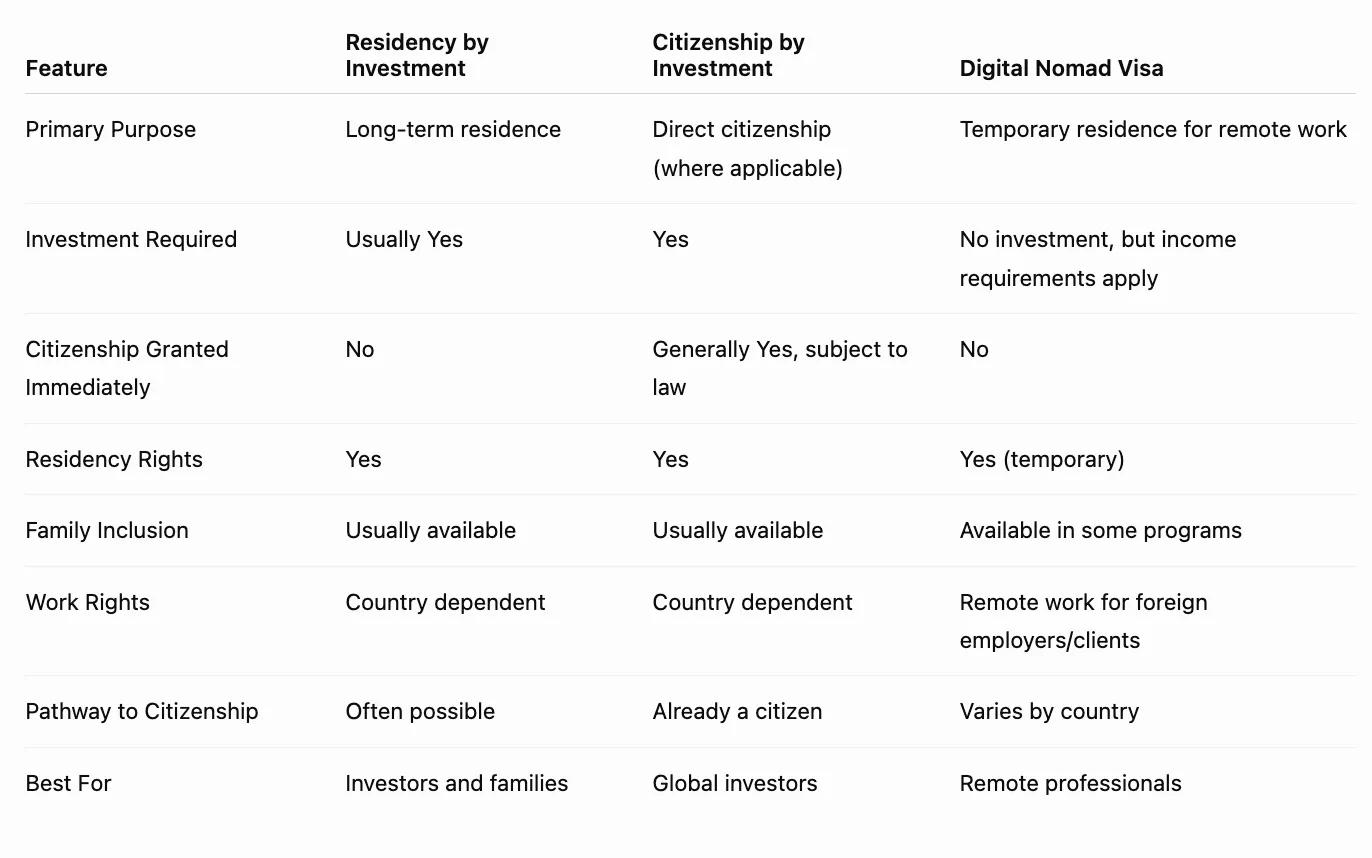
There is no universally "best" global mobility pathway. The right choice depends on your objectives. Investors focused on long-term settlement often benefit from Residency by Investment, those seeking an additional nationality may consider Citizenship by Investment where legally available, and remote professionals generally find Digital Nomad Visas to be the most practical solution for location-independent living.
How to Choose the Right Global Mobility Pathway
Choosing the right immigration pathway is one of the most important decisions you'll make when planning your international future. While many people initially compare programs based on investment requirements or processing times, these are only two pieces of a much larger picture.
The ideal program should align with your long-term objectives, financial capacity, family priorities, lifestyle preferences, and business ambitions. A program that is perfect for a remote software engineer may not be suitable for an entrepreneur looking to expand into European markets or a family seeking access to world-class education.
Before exploring specific countries, take the time to define what success looks like for you. Your answers will help narrow down the most appropriate immigration pathway.
Step 1: Define Your Primary Goal
The first question to ask yourself is simple:
Why do you want to relocate or establish residency abroad?
Your objective should drive every decision that follows.
Common Goals Include:
Lifestyle Improvement
Many individuals seek a better quality of life, safer communities, improved healthcare, favorable climates, or a healthier work-life balance.
Recommended Pathways:
Business Expansion
Entrepreneurs often establish residency in strategic jurisdictions to simplify company formation, banking, taxation, and access to international markets.
Recommended Pathway:
International Mobility
Some applicants prioritize greater travel freedom and easier access to international destinations.
Recommended Pathway:
Family Security
Parents frequently relocate to provide children with stronger educational opportunities, healthcare systems, and long-term stability.
Recommended Pathway:
Remote Work Lifestyle
Professionals working online may simply want the freedom to legally live abroad while maintaining employment with overseas companies.
Recommended Pathway:
Step 2: Understand Your Budget
Different programs require different financial commitments.
While cost should never be the only deciding factor, it is important to establish a realistic budget before comparing countries.
Budget Considerations
Government application fees
Investment requirements
Professional service fees
Legal expenses
Due diligence fees
Property costs (if applicable)
Renewal fees
Living expenses after relocation
A lower investment requirement does not always mean a better overall value. Long-term benefits should also be considered.
Instead of asking "Which program is the cheapest?", ask "Which program delivers the greatest long-term value for my objectives?" The lowest-cost option may not provide the residency rights, family benefits, or citizenship pathway you ultimately need.
Step 3: Consider Your Family
If your spouse, children, or dependent parents may relocate with you, carefully compare family eligibility requirements.
Questions to consider include:
Can my spouse be included?
Are dependent children eligible?
Can parents or grandparents be added?
Do children receive residency or citizenship automatically?
Will my family have access to healthcare?
Can children attend public schools?
What happens when children reach adulthood?
Some programs are significantly more family-friendly than others.
Step 4: Evaluate Residency Requirements
Not every program requires you to physically live in the country.
Some Residency by Investment programs require only occasional visits, while others expect applicants to spend substantial time each year to maintain residency or qualify for citizenship.
Questions to ask:
Is physical residence mandatory?
How many days per year are required?
Can residency be maintained while living elsewhere?
Are there renewal obligations?
These requirements can have a major impact on your long-term plans.
Step 5: Consider Tax Implications
Taxation is often one of the most misunderstood aspects of international relocation.
Obtaining residency does not automatically make you a tax resident. Likewise, becoming a tax resident depends on each country's domestic tax laws and your individual circumstances.
Areas to understand include:
Income tax
Capital gains tax
Wealth tax
Inheritance tax
Corporate taxation
Double taxation agreements
Foreign income treatment
Important Note
Tax planning should always be discussed with qualified legal and tax professionals familiar with both your home country and your intended destination.
Step 6: Think Long-Term
Ask yourself:
Where do you see yourself in ten years?
Your answer can significantly influence which program is most appropriate.
For example:
Do you eventually want citizenship?
Would you like permanent residency?
Do you expect to relocate permanently?
Are you looking for a retirement destination?
Will your children study abroad?
Do you expect to expand your business internationally?
A long-term perspective often leads to better decisions than focusing solely on immediate costs.
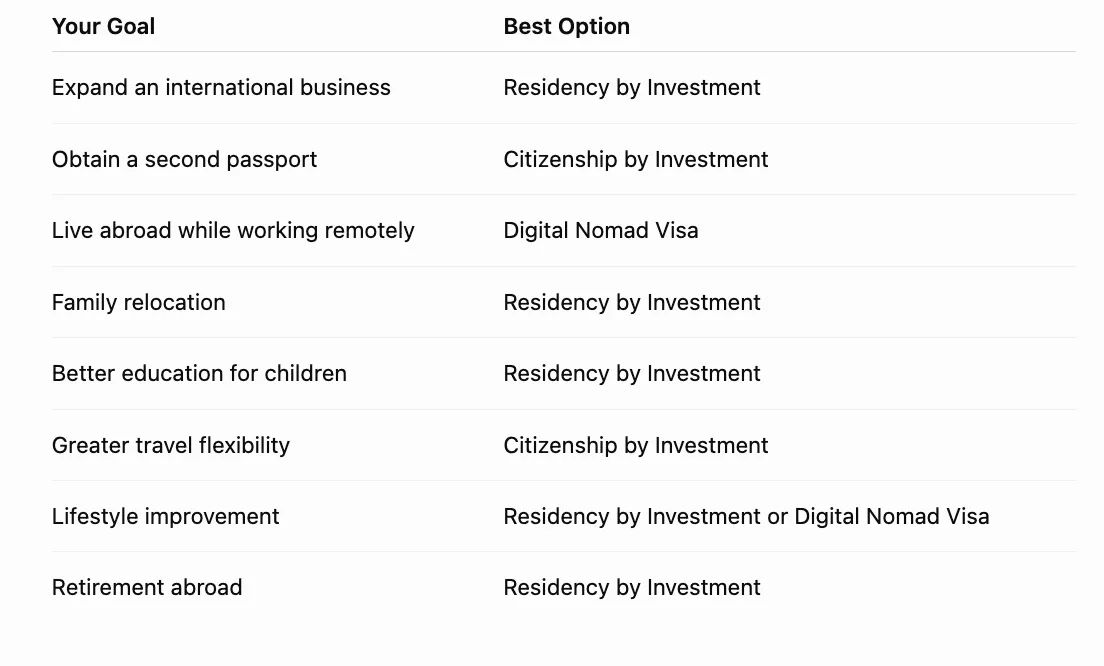
Comparing the Right Pathway Based on Your Goals
Real-World Scenarios
Understanding how different individuals approach global mobility can make the decision-making process much easier.
Scenario 1: The Entrepreneur
Sarah owns a technology company serving clients across Europe and the Middle East. She wants easier access to European markets, banking opportunities, and the flexibility to relocate in the future without immediately changing her citizenship.
Recommended Pathway
Residency by Investment
Why?
Long-term business presence
Access to European markets
Potential pathway to citizenship
Family inclusion
Scenario 2: The Global Investor
Ahmed travels internationally every month and wants to diversify his family's future while improving international mobility.
Recommended Pathway
Why?
Additional citizenship
Enhanced travel flexibility
Family security
Long-term succession planning
Scenario 3: The Remote Software Engineer
Emma works remotely for an international company and wants to spend a year living in Southern Europe while continuing her existing employment.
Recommended Pathway
Digital Nomad Visa
Why?
Designed specifically for remote workers
Legal long-term stay
No investment requirement
Flexible lifestyle
Scenario 4: The Young Family
David and Maria want their children to grow up with access to excellent education, healthcare, and a stable environment while preserving their existing nationality.
Recommended Pathway
Residency by Investment
Why?
Family-focused benefits
Education opportunities
Long-term residency
Potential future citizenship
Common Mistakes to Avoid
Even experienced investors can make costly mistakes when evaluating immigration programs.
Avoid these common pitfalls:
Choosing Based Only on Price
The least expensive option may not align with your long-term objectives.
Ignoring Tax Consequences
Immigration and taxation are separate legal concepts.
Always seek professional tax advice before relocating.
Focusing Only on Processing Time
Fast approvals are attractive, but long-term benefits matter more.
Not Considering Family Needs
Ensure the program supports your spouse, children, and other eligible dependents if family relocation is part of your plan.
Assuming Every Country Offers the Same Benefits
Each jurisdiction has unique laws regarding residency rights, work permissions, naturalization pathways, and renewal requirements.
Never assume programs are directly comparable.
The most successful applicants begin by defining their goals—not by choosing a country. Once your priorities are clear, selecting the right jurisdiction becomes a much more objective and strategic process.
Global Mobility Decision Checklist
Before selecting a program, ask yourself:
✔ What is my primary objective?
✔ How much am I prepared to invest?
✔ Will my family relocate with me?
✔ Do I eventually want citizenship?
✔ How important is visa-free travel?
✔ Do I need business expansion opportunities?
✔ Am I comfortable meeting residency requirements?
✔ Have I considered tax implications?
✔ Does the program align with my long-term plans?
If you can confidently answer these questions, you'll be in a much stronger position to evaluate countries and immigration programs objectively.
The Benefits of Global Mobility
Global mobility is about much more than relocating to another country. For many individuals and families, it represents a long-term strategy for expanding opportunities, protecting wealth, improving quality of life, and building a more resilient future.
Whether you're an entrepreneur, investor, remote professional, or retiree, the right immigration pathway can provide advantages that extend well beyond a residence permit or passport.
Below are some of the most significant benefits of embracing global mobility.
1. Greater Freedom to Live Internationally
One of the most immediate benefits of global mobility is the ability to establish a legal presence in another country.
Rather than being limited to short tourist stays, eligible individuals can enjoy the stability of legal residency or citizenship, allowing them to build a life abroad with greater certainty.
This often provides access to:
Long-term accommodation
Local banking services
Utility connections
Healthcare systems
Education
Everyday public services
Having the legal right to reside in another country offers peace of mind and greater flexibility for both personal and professional planning.
2. Increased Global Travel Flexibility
International travel has become an essential part of modern business and lifestyle planning.
Depending on the immigration pathway and destination country, residency or citizenship may simplify travel across regional agreements or provide access to broader visa-free or visa-on-arrival opportunities.
For frequent travelers, business owners, and internationally active families, this increased mobility can reduce administrative burdens and make cross-border travel more convenient.
Why It Matters
Easier business travel
Greater travel flexibility
Reduced visa application requirements for certain destinations
Simplified international movement where applicable
Travel benefits should never be the sole reason for selecting an immigration program. They should be evaluated alongside residency rights, long-term stability, family inclusion, and legal obligations.
3. Business Expansion Opportunities
For entrepreneurs and investors, global mobility can create valuable opportunities to operate internationally.
Establishing legal residency in another jurisdiction may support:
Company formation
Access to new markets
International banking relationships
Investor confidence
Cross-border partnerships
Regional expansion strategies
Many entrepreneurs view international residency as part of a broader business growth plan rather than simply an immigration decision.
4. Diversification of Personal and Financial Assets
Diversification is a well-established risk management strategy.
Just as investors diversify financial portfolios across industries and asset classes, many individuals choose to diversify geographically by establishing residency or citizenship in another country.
This may provide greater flexibility when managing:
Property ownership
Business interests
Banking relationships
Family succession planning
International investments
Global mobility can become one component of a broader long-term wealth strategy.
5. Access to Quality Education
Education is one of the strongest motivations for family relocation.
Many Residency by Investment programs allow eligible family members to relocate together, giving children access to internationally recognized schools and universities.
Potential benefits include:
International curricula
Multilingual education
Globally recognized qualifications
Improved university pathways
Diverse cultural experiences
For many parents, investing in global mobility is ultimately an investment in their children's future.
6. Healthcare Access
Healthcare standards vary considerably around the world.
Relocating to a country with well-developed healthcare infrastructure can provide:
Modern medical facilities
Preventive healthcare
Specialist treatment options
Comprehensive insurance systems
Higher standards of patient care
Healthcare access often becomes increasingly important for retirees and families with young children.
7. Lifestyle Flexibility
Global mobility gives individuals the freedom to choose where they live based on personal preferences rather than geographical limitations.
People increasingly relocate to enjoy:
Better climate
Lower living costs
Improved safety
Outdoor lifestyles
Cultural experiences
Slower pace of life
Stronger work-life balance
Digital Nomad Visas have accelerated this trend by allowing professionals to work remotely while living abroad.
8. Family Security
Many immigration programs allow applicants to include eligible family members.
This creates opportunities for families to build long-term security together through:
Stable residency
Educational opportunities
Healthcare access
Future citizenship pathways (where available)
Greater international flexibility
For many applicants, family well-being becomes the deciding factor when comparing immigration programs.
Successful global mobility planning should consider not only your own future but also the opportunities available to your spouse, children, and future generations.
9. Long-Term Residency and Citizenship Opportunities
Many Residency by Investment programs are designed as long-term immigration pathways.
While requirements differ between jurisdictions, maintaining residency over time may create opportunities to apply for:
Permanent residency
Long-term residence permits
Naturalization
Citizenship (subject to national laws)
Applicants should always review each country's residency obligations, language requirements, and naturalization criteria before making long-term plans.
10. Greater Personal Freedom
Perhaps the greatest advantage of global mobility is freedom of choice.
Rather than relying on a single country for every aspect of life, individuals can make decisions based on:
Career opportunities
Business growth
Family priorities
Lifestyle preferences
Retirement planning
Investment strategies
This flexibility enables people to adapt more effectively as their personal and professional circumstances evolve.
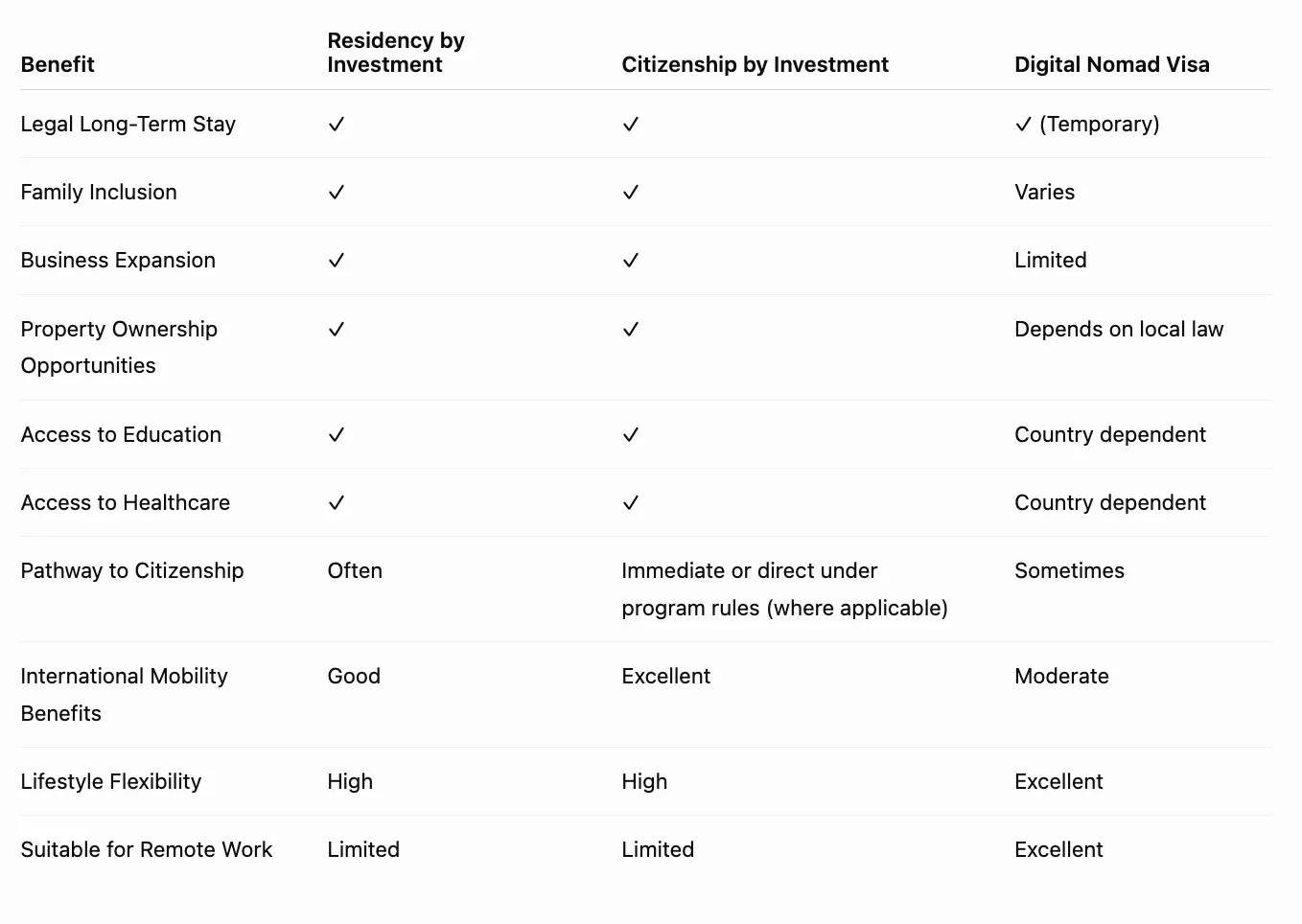
Comparing the Benefits of Each Pathway
Popular Global Mobility Destinations
Every country offers a unique combination of benefits, investment requirements, and long-term opportunities. The right destination depends on your individual objectives rather than a single "best" program.
Europe
Popular for:
Residency pathways
High quality of life
Education
Healthcare
Access to the Schengen Area
Business opportunities
Examples include:
Caribbean
Known for:
Citizenship by Investment programs
International mobility
Family inclusion
Efficient processing in some jurisdictions
Examples include:
Middle East
Popular among entrepreneurs because of:
Modern infrastructure
International business environment
Strategic geographic location
Investment opportunities
Examples include:
Asia
Increasingly attractive due to:
Economic growth
Business ecosystems
Technology sectors
Regional market access
Examples include:
How to Compare Countries Effectively
Instead of asking:
"Which country is the best?"
Ask:
"Which country is best for my goals?"
Consider the following factors:
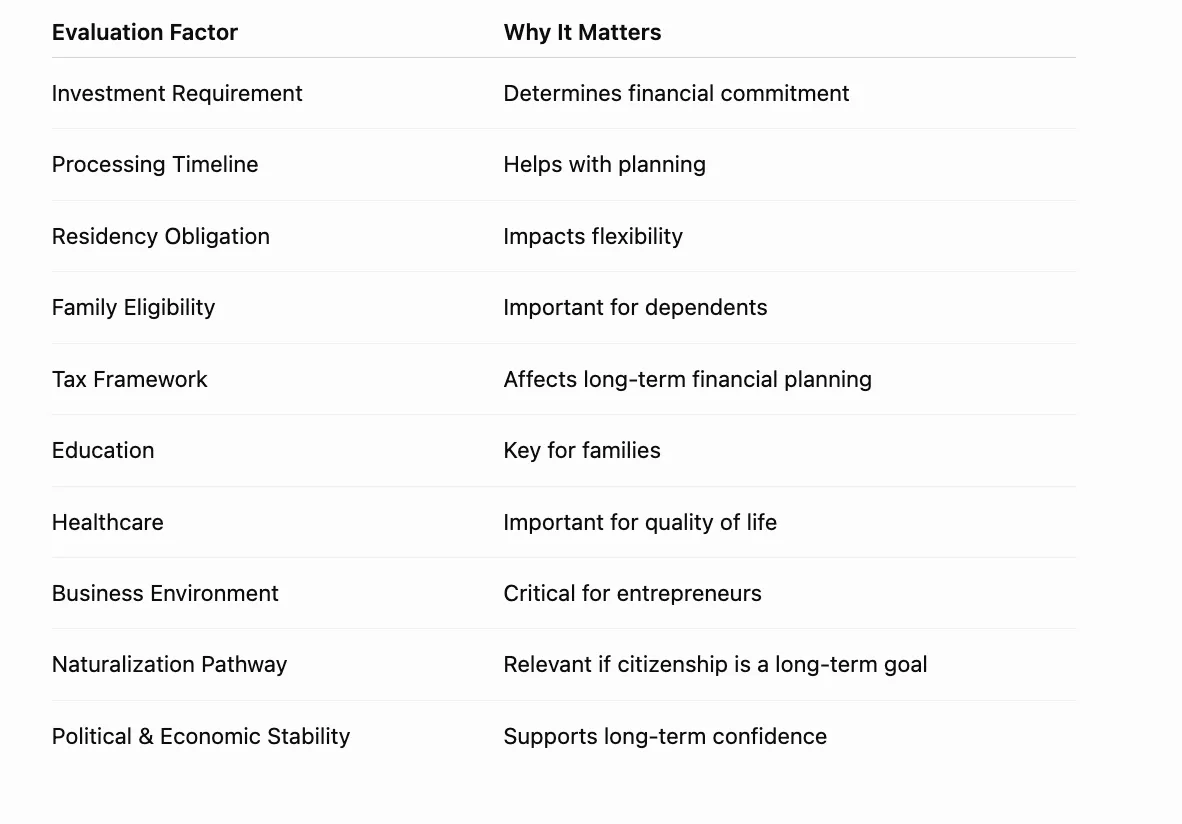
The strongest immigration strategy is one that supports your life five, ten, or even twenty years from now—not just your immediate relocation plans. Evaluate countries based on long-term compatibility rather than short-term popularity or marketing claims.
Common Myths About Global Mobility
As international relocation has become more accessible, misinformation has also become more widespread. Misunderstanding how immigration programs work can lead to unrealistic expectations and poor decisions.
Let's address some of the most common myths.
Myth 1: Global Mobility Is Only for Millionaires
Reality
While some Citizenship by Investment programs require substantial financial contributions, many global mobility options are available to entrepreneurs, professionals, retirees, and remote workers.
Examples include:
Entrepreneur Visas
Startup Visas
Retirement Residency Programs
Global mobility today serves a much broader audience than it did a decade ago.
Myth 2: Residency Means Citizenship
Reality
Residency and citizenship are two separate legal statuses.
Residency generally allows you to legally live in a country, while citizenship provides additional legal rights and responsibilities under that country's laws.
Many residency programs may offer a pathway to citizenship through naturalization if applicants continue to meet the relevant legal requirements, but residency does not automatically become citizenship.
Myth 3: Every Program Offers the Same Benefits
Reality
Every country designs its immigration framework differently.
Programs vary in:
Investment requirements
Processing timelines
Family eligibility
Residency obligations
Renewal conditions
Tax rules
Naturalization pathways
Comparing countries solely by investment amount rarely provides the full picture.
Myth 4: Digital Nomad Visas Are Tourist Visas
Reality
Digital Nomad Visas are specifically designed for eligible remote professionals who earn income from employers or clients outside the host country.
They generally provide a legal basis for longer stays than a standard tourist visa, subject to each country's rules.
Myth 5: The Fastest Program Is Always the Best
Reality
Processing speed is only one factor.
Applicants should also evaluate:
Long-term objectives
Family needs
Business opportunities
Residency obligations
Tax implications
Future citizenship options
A program that aligns with your long-term goals will often provide greater value than one chosen solely for speed.
How Zenvify Simplifies Global Mobility
Choosing an immigration pathway can feel overwhelming, especially when comparing dozens of countries, investment options, and legal requirements.
Zenvify is designed to simplify that process by bringing trusted information, comparison tools, and structured guidance together in one platform.
Instead of visiting multiple websites or comparing programs manually, users can explore immigration pathways through a single, organized experience.
With Zenvify, you can:
Compare Immigration Programs
Evaluate Residency by Investment, Citizenship by Investment, and Digital Nomad Visa programs side by side based on eligibility, investment requirements, timelines, family inclusion, and long-term opportunities.
Explore Country Guides
Access detailed information about each participating country, including:
Eligibility requirements
Investment options
Application process
Residency obligations
Benefits
Processing timelines
Family inclusion
Citizenship pathways (where applicable)
Generate a Personalized Immigration Roadmap
Every applicant has different priorities.
Rather than presenting generic recommendations, Zenvify helps you generate a personalized roadmap based on your:
Goals
Budget
Family situation
Preferred regions
Timeline
Long-term plans
This provides a structured starting point for evaluating suitable programs.
Make Better-Informed Decisions
By combining educational content, comparison tools, and country-specific information, Zenvify helps users understand not only which programs exist, but also which ones may align best with their objectives.
Expert Insight
The best immigration decision isn't necessarily the most popular one—it's the one that aligns with your personal goals, financial circumstances, family priorities, and long-term plans. Taking time to compare programs objectively can lead to better outcomes than focusing on a single country or headline investment amount.
Your Global Mobility Checklist
Before beginning your international relocation journey, take a moment to review the following checklist.
Personal Goals
☐ Why do I want to relocate?
☐ What am I hoping to achieve?
☐ Is my priority lifestyle, business, education, retirement, or travel?
Financial Planning
☐ Have I established a realistic budget?
☐ Have I considered application and legal costs?
☐ Have I reviewed long-term living expenses?
Family Considerations
☐ Will my family relocate with me?
☐ Are my dependents eligible?
☐ Have I evaluated education and healthcare?
Long-Term Planning
☐ Do I eventually want citizenship?
☐ Am I prepared to meet residency requirements?
☐ Have I considered future business opportunities?
Professional Advice
☐ Have I reviewed the legal requirements?
☐ Have I considered tax implications?
☐ Do I understand the obligations after approval?
Completing this checklist before selecting a program can help you approach your decision with greater clarity and confidence.
Final Thoughts
Global mobility is no longer a niche concept reserved for multinational corporations or a small group of international investors. It has become a practical strategy for entrepreneurs expanding into new markets, families seeking greater security, professionals embracing remote work, and individuals looking to diversify their future through legal international residency or citizenship options.
The right pathway will always depend on your personal objectives. Some applicants prioritize establishing residency in a stable country with long-term naturalization opportunities. Others seek the flexibility of an additional citizenship or the freedom to work remotely while experiencing different cultures. There is no universal solution—only the solution that best aligns with your goals.
As governments continue to refine immigration programs and introduce new opportunities, staying informed becomes increasingly important. Understanding the differences between Residency by Investment, Citizenship by Investment, and Digital Nomad Visas is the first step toward making a confident and well-informed decision.
Whether you're exploring international expansion, planning a future relocation, or simply researching your options, taking a structured and objective approach will help you identify the pathway that supports both your immediate needs and your long-term aspirations.
Begin Your Global Mobility Journey with Zenvify
Ready to take the next step?
Zenvify provides the tools and resources to help you move forward with confidence.
Compare Immigration Programs
Evaluate Residency by Investment, Citizenship by Investment, and Digital Nomad Visa options side by side.
Generate Your Personalized Immigration Roadmap
Receive a structured roadmap tailored to your goals, preferred destination, budget, and long-term plans.
Explore Country Guides
Discover detailed information on immigration programs from countries around the world, including eligibility, investment options, timelines, and benefits.
Make Better Decisions with Confidence
Use trusted educational resources and comparison tools to better understand your options before starting your immigration journey.
Ready to explore your options?
Book a Free Consultation