

International relocation has evolved far beyond traditional immigration routes. Today, investors, entrepreneurs, retirees, and families increasingly look for flexible ways to establish legal residency abroad while preserving future opportunities. Residency by Investment, often referred to as a Golden Visa in many countries, has become one of the most popular pathways for achieving this goal.
Unlike immigration routes based solely on employment or family sponsorship, Residency by Investment programs are designed to attract foreign capital while offering eligible applicants the right to live, and in many cases study, work, or establish a business in the host country, subject to local laws. Depending on the jurisdiction, these programs may also create a pathway toward permanent residency or citizenship after fulfilling specific legal and residency requirements.
However, not every Golden Visa program offers the same advantages. Investment thresholds, qualifying assets, residency obligations, renewal conditions, tax considerations, and family eligibility can vary significantly from one country to another. Choosing the right program requires more than comparing costs—it requires understanding how each option aligns with your long-term goals.
This guide provides a comprehensive overview of Residency by Investment programs around the world. You'll learn how they work, who they are designed for, the benefits and responsibilities they involve, and the key factors to evaluate before selecting the program that best fits your lifestyle, business ambitions, family priorities, and future plans.
Key Takeaways
Quick Summary
Learn what Residency by Investment is and how Golden Visa programs work.
Understand the differences between residency, permanent residency, and citizenship.
Compare investment options, eligibility criteria, residency obligations, and long-term benefits.
Discover which countries offer leading Residency by Investment programs.
Learn how to choose the right program based on your goals, budget, and family needs.
Explore how Zenvify helps you compare countries and generate a personalized immigration roadmap.
What Is Residency by Investment?
Residency by Investment (RBI) is a legal immigration pathway that enables eligible foreign nationals to obtain the right to reside in another country by making a qualifying investment. These programs are designed to attract foreign capital while offering investors and their families access to long-term residency benefits, business opportunities, and, in some jurisdictions, a pathway to permanent residency or citizenship.
The qualifying investment varies by country and may include government-approved real estate purchases, investment funds, business ventures, job creation initiatives, or other economic contributions. Unlike traditional immigration routes based on employment or family sponsorship, Residency by Investment programs focus on encouraging economic development through foreign investment.
Many Residency by Investment programs are commonly referred to as Golden Visa programs, particularly in Europe. While the term "Golden Visa" is widely recognized, it is important to understand that not every Residency by Investment program officially uses this name. Some countries issue residence permits under different legislative frameworks while providing similar benefits.
A successful application generally grants the investor—and, where permitted, eligible family members—the legal right to reside in the host country. Depending on national legislation, residents may also gain access to education, healthcare, business opportunities, banking services, and regional travel benefits.
For many applicants, Residency by Investment is not simply about relocating. It is a strategic tool for international diversification, family security, business expansion, and long-term global mobility.
Why Residency by Investment Programs Exist
Residency by Investment programs are designed to create mutual benefits for both governments and applicants.
Governments use these programs to attract responsible foreign investment that contributes to economic development, infrastructure, business growth, innovation, and employment. The capital generated through qualifying investments can support national development priorities while increasing international competitiveness.
Applicants, in turn, gain access to legal residency and the opportunity to establish a presence in a country that aligns with their personal, financial, or business objectives.
This creates a mutually beneficial relationship where investment contributes to economic growth while providing investors with greater international flexibility.
Primary Objectives for Governments
Residency by Investment programs generally aim to:
Attract foreign direct investment (FDI).
Support national economic growth.
Stimulate real estate and development projects where applicable.
Encourage entrepreneurship and innovation.
Create employment opportunities.
Increase international competitiveness.
Diversify sources of foreign capital.
Each country structures its program differently based on its economic priorities and immigration policies.
Why Applicants Choose Residency by Investment
While every investor has unique goals, the most common reasons for pursuing Residency by Investment include:
Establishing legal residency in another country.
Expanding international business operations.
Diversifying assets across jurisdictions.
Improving lifestyle options.
Accessing quality education and healthcare.
Creating long-term opportunities for family members.
Planning for eventual permanent residency or citizenship, where available.
The best program depends on the applicant's individual circumstances rather than a single investment amount or destination.
Expert Insight
Residency by Investment should be viewed as a long-term strategic decision rather than a short-term transaction. The strongest programs are those that align with your future business plans, family priorities, and lifestyle—not simply the ones with the lowest investment requirement.
How Does a Residency by Investment Program Work?
Although the application process differs between countries, most Residency by Investment programs follow a similar sequence.
Step 1: Choose the Right Program
Begin by evaluating countries based on your objectives, budget, residency obligations, investment options, and long-term plans.
Step 2: Confirm Eligibility
Review the program's eligibility criteria, including:
Minimum age requirements.
Financial capacity.
Source of investment funds.
Clean criminal record.
Health insurance (where required).
Supporting documentation.
Step 3: Select a Qualifying Investment
Depending on the country, qualifying investments may include:
Government-approved real estate.
Investment funds.
Business investments.
Venture capital.
Job creation projects.
Government contribution schemes.
Not every investment type is available in every jurisdiction.
Step 4: Submit the Application
Applicants typically submit:
Identity documents.
Financial records.
Proof of investment.
Background documentation.
Family documentation (if applicable).
Many jurisdictions also conduct comprehensive due diligence before approval.
Step 5: Complete Due Diligence
Governments review applications to verify identity, financial integrity, and compliance with program requirements.
Due diligence helps maintain the credibility and integrity of Residency by Investment programs.
Step 6: Receive Your Residence Permit
Once approved and all legal requirements have been satisfied, applicants receive a residence permit in accordance with the country's immigration laws.
The permit may be temporary or long-term, depending on the specific program.
Step 7: Renew and Maintain Residency
Many Residency by Investment programs require periodic renewal.
Renewal may depend on:
Maintaining the qualifying investment.
Meeting minimum residency requirements.
Continuing to satisfy legal obligations.
Step 8: Long-Term Options
Some jurisdictions provide a pathway toward:
Permanent residency.
Long-term residence.
Citizenship through naturalization.
These opportunities are governed by each country's laws and often require applicants to meet additional residency, language, integration, or legal requirements.
Typical Residency by Investment Journey
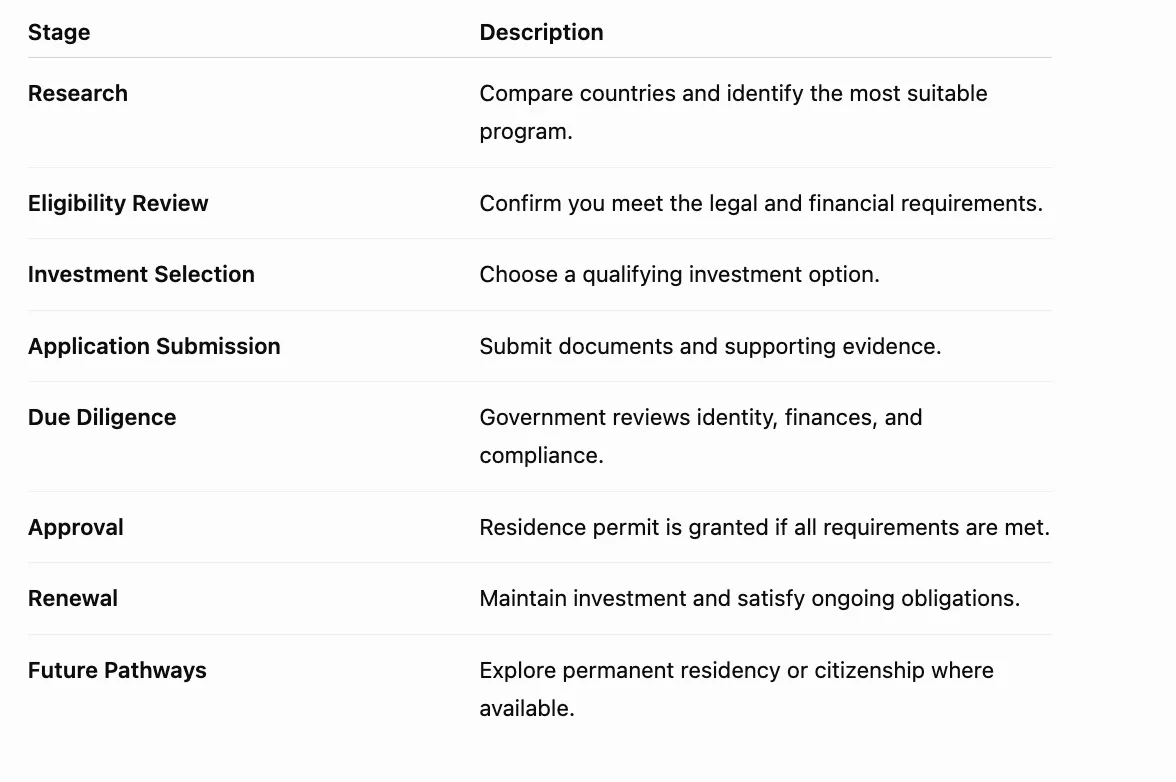
Why Understanding the Process Matters
Many applicants focus primarily on investment thresholds or processing times. While these are important considerations, the overall application journey involves legal compliance, documentation, due diligence, and ongoing obligations that vary between jurisdictions.
A clear understanding of the process helps applicants prepare effectively, avoid common mistakes, and compare programs on more than just cost.
Residency by Investment vs. Citizenship by Investment
One of the most common misconceptions in investment migration is that residency and citizenship are the same. While both provide legal status in another country, they differ significantly in terms of rights, responsibilities, and long-term outcomes.
Choosing between Residency by Investment and Citizenship by Investment depends on your personal objectives, investment strategy, family needs, and future plans.
What Is Residency by Investment?
Residency by Investment grants eligible foreign nationals the legal right to reside in a country after making a qualifying investment. The applicant remains a citizen of their original country while enjoying residency rights under the laws of the host nation.
Depending on the program, residents may be permitted to live, work, study, establish a business, purchase property, or access healthcare and education. Some programs also create a pathway to permanent residency or citizenship after meeting residency and legal requirements.
What Is Citizenship by Investment?
Citizenship by Investment allows eligible applicants to obtain citizenship by making a qualifying investment or economic contribution under a country's legislation.
Successful applicants generally receive citizenship together with the rights and responsibilities that accompany it, including a passport issued by that country, subject to its laws.
Unlike Residency by Investment, Citizenship by Investment does not usually require applicants to first spend several years as residents before becoming citizens, although every jurisdiction has its own legal framework.
Key Differences at a Glance
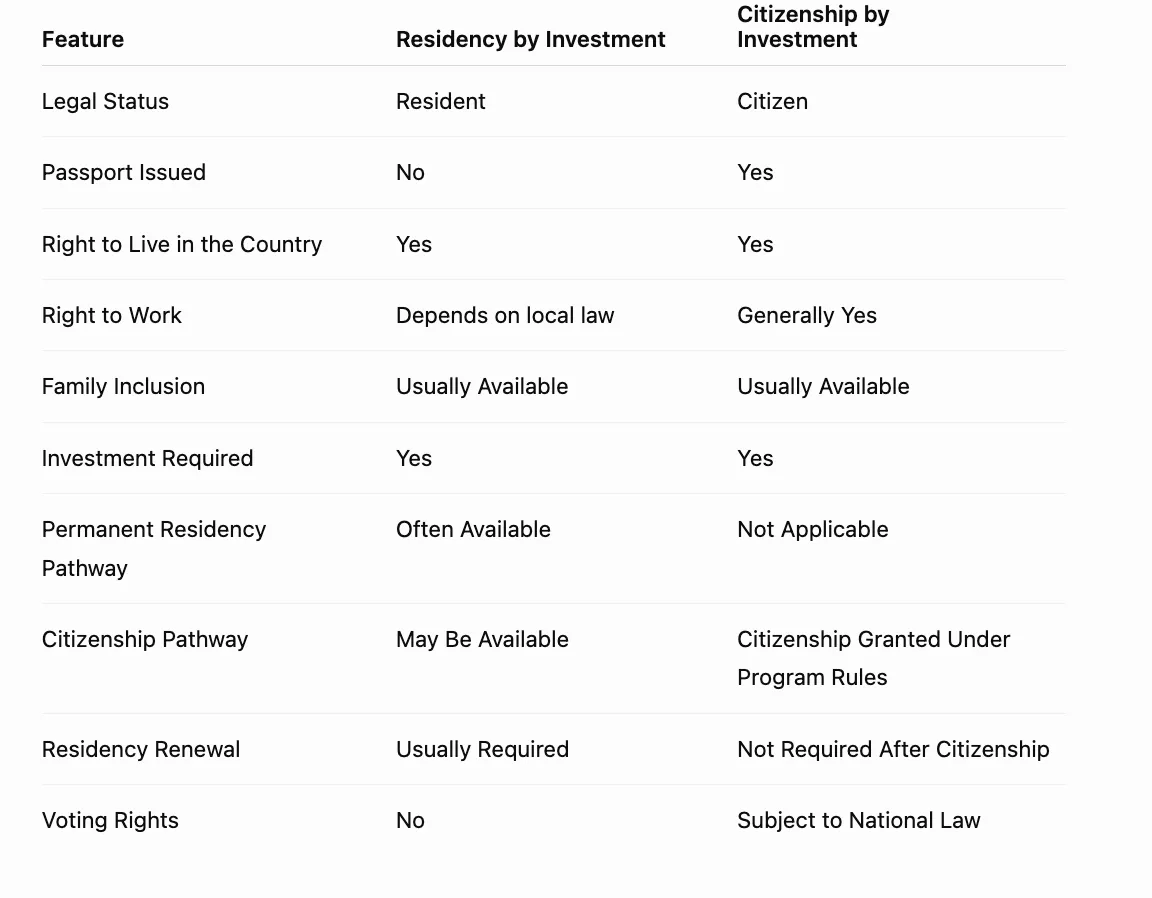
Which Option Is Right for You?
Residency by Investment may be suitable if you:
Want to relocate gradually.
Plan to expand a business internationally.
Are seeking better education or healthcare for your family.
Prefer a lower initial financial commitment in some jurisdictions.
Wish to keep your options open before pursuing citizenship.
Citizenship by Investment may be more appropriate if you:
Want an additional nationality.
Value enhanced international mobility.
Are focused on long-term family succession planning.
Need greater flexibility for international business.
Prefer immediate citizenship where legally available.
Expert Insight
The decision should be based on your long-term objectives rather than the type of document you receive. For many investors, residency is the first step toward building an international lifestyle, while citizenship may become a future objective after gaining experience living or investing abroad.
Residency by Investment vs. Permanent Residency
Another area that often causes confusion is the distinction between temporary residency obtained through investment and permanent residency.
These are not interchangeable terms.
Residency by Investment
Residency by Investment usually begins with a temporary or renewable residence permit.
To maintain residency, applicants may need to:
Maintain the qualifying investment.
Renew the residence permit periodically.
Comply with minimum residency requirements where applicable.
Continue meeting program conditions.
The exact obligations vary between countries.
Permanent Residency
Permanent residency generally provides the right to live in a country indefinitely without the need for frequent permit renewals.
Permanent residents often enjoy greater stability than temporary residents but usually remain foreign nationals rather than citizens.
Permanent residency does not automatically confer citizenship, voting rights, or a passport.
Many countries require applicants to complete several years of legal residence before becoming eligible for permanent residency.
Residency vs. Permanent Residency
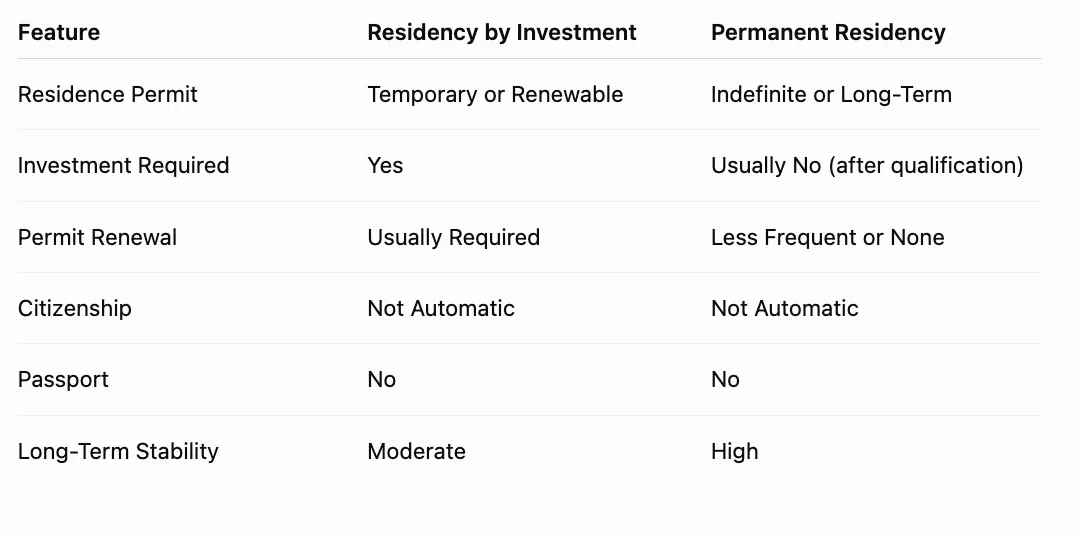
What Is a Golden Visa?
The term Golden Visa is one of the most widely recognized phrases in investment migration, but it is also one of the most misunderstood.
A Golden Visa is not a separate immigration category. Instead, it is a commonly used name for certain Residency by Investment programs that grant residence rights in exchange for a qualifying investment.
Several countries use the term "Golden Visa" in official or public communications, while others operate similar investment-based residence programs under different names.
For example, one country may offer a Golden Visa, while another may issue a Residence Permit by Investment or an Investor Residence Program. Although the names differ, the underlying concept is often similar: a qualifying investment can provide legal residency, subject to the country's laws.
Are All Residency by Investment Programs Golden Visas?
No.
Although the terms are often used interchangeably, not every Residency by Investment program is officially called a Golden Visa.
For example:
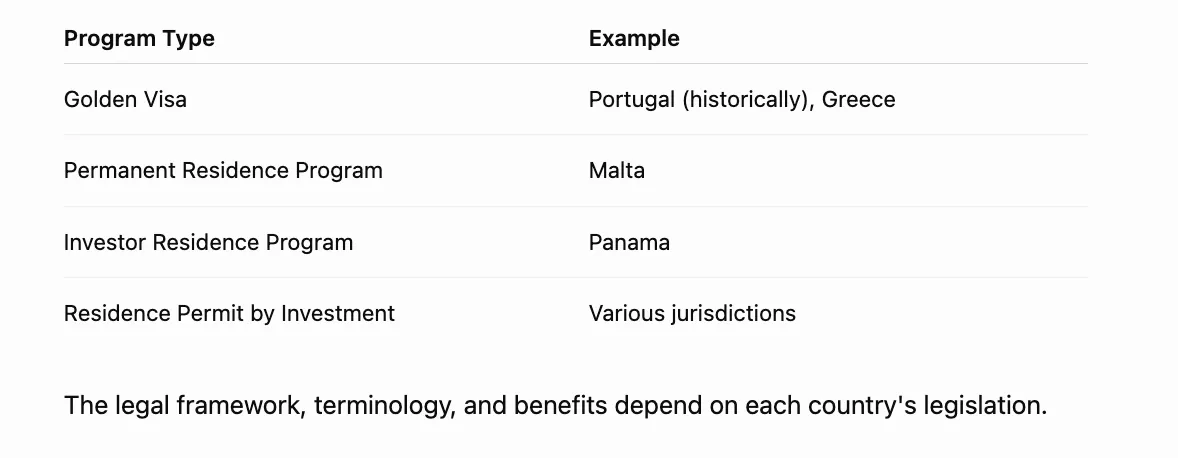
Common Benefits of Golden Visa Programs
Many Golden Visa-style programs may offer:
Legal residency.
Family inclusion.
Access to healthcare and education (subject to local rules).
Business and investment opportunities.
Property ownership (where permitted).
Potential pathways to permanent residency or citizenship.
Greater international mobility.
However, applicants should evaluate each program individually rather than assuming all Golden Visa programs provide identical benefits.
Expert Insight
The name of a program is less important than its legal framework. Two programs may both be marketed as "Golden Visas," yet differ substantially in investment options, residency obligations, renewal requirements, and long-term opportunities. Always compare the underlying rules—not just the branding.
Why Residency by Investment Continues to Grow
The popularity of Residency by Investment programs has increased significantly as more individuals seek greater flexibility in where they live, work, invest, and plan for the future.
Several factors contribute to this growing demand:
Increased globalization.
Expansion of remote and international business.
Greater interest in geographic diversification.
Family education planning.
Access to quality healthcare.
Long-term wealth and succession planning.
Lifestyle flexibility.
For many applicants, Residency by Investment is no longer simply an immigration option—it has become part of a broader international planning strategy.
Benefits of Residency by Investment
Residency by Investment is more than an immigration pathway—it is a long-term strategy for expanding personal, professional, and financial opportunities across international borders. While the benefits vary depending on the country and program selected, many investors choose Residency by Investment because it offers flexibility without requiring an immediate change of citizenship.
Whether your goal is business expansion, family security, or lifestyle improvement, understanding the potential advantages can help you determine whether a Residency by Investment program aligns with your long-term objectives.
1. Legal Residency in Another Country
The primary benefit of Residency by Investment is obtaining the legal right to reside in another country through a qualifying investment.
Depending on the country's laws, residency may allow you to:
Live in the country full-time or part-time.
Rent or purchase residential property.
Access local services.
Establish a long-term presence.
Renew your residency while maintaining eligibility.
For many applicants, legal residency provides greater stability than temporary visas and creates opportunities that extend beyond tourism or short-term business travel.
2. A Potential Pathway to Permanent Residency and Citizenship
Many Residency by Investment programs are designed as long-term immigration pathways.
While requirements vary, maintaining residency and meeting legal obligations may allow eligible applicants to apply for:
Permanent Residency
Long-Term Residence
Citizenship through Naturalization
Applicants should understand that these pathways differ significantly between countries. Factors such as minimum residency periods, language proficiency, integration requirements, and physical presence obligations often influence eligibility.
Expert Insight
If obtaining citizenship is one of your long-term goals, evaluate the entire residency-to-citizenship journey—not just the initial residence permit. The investment amount is only one part of the overall strategy.
3. Family Inclusion
Many Residency by Investment programs allow applicants to include eligible family members within a single application.
Depending on the jurisdiction, this may include:
Spouse
Dependent children
Adult children under specific conditions
Dependent parents
Dependent grandparents
Family inclusion makes Residency by Investment particularly attractive for individuals seeking greater educational opportunities, healthcare access, and long-term security for future generations.
Before applying, applicants should carefully review each country's eligibility criteria, as family definitions and dependency rules differ across programs.
4. Access to Education
Education is one of the strongest motivations for international relocation.
Residency status may provide families with opportunities to access:
International schools
Public education systems (where eligible)
Private educational institutions
International universities
Multilingual learning environments
For parents, Residency by Investment is often viewed as an investment in future educational opportunities rather than simply a change of residence.
5. Access to Healthcare
Healthcare standards vary considerably across the world.
Many Residency by Investment destinations offer access to well-developed healthcare systems, although eligibility and coverage depend on local regulations and the applicant's residency status.
Potential advantages may include:
Modern hospitals
Specialist medical services
Preventive healthcare
Emergency treatment
Private health insurance options
Applicants should always review the healthcare rights associated with each residency program before making a decision.
6. Business Expansion Opportunities
Residency by Investment can also support entrepreneurs and business owners seeking international growth.
Establishing legal residency may simplify:
Company formation
International banking relationships
Cross-border investment
Regional market access
Commercial partnerships
Many investors view residency as part of a broader international business strategy rather than solely an immigration decision.
7. Greater Lifestyle Flexibility
Residency by Investment offers individuals the flexibility to choose where they live based on their personal and professional priorities.
Popular reasons for relocating include:
Better climate
Improved work-life balance
Higher standards of living
Safety and stability
Cultural experiences
Retirement planning
Rather than relocating permanently immediately, many residents initially divide their time between countries while evaluating long-term options.
8. Geographic Diversification
Diversification is a common principle in financial planning, and many investors apply the same concept to residency.
Holding legal residency in another jurisdiction may contribute to broader international planning by supporting:
Geographic diversification
Cross-border business activities
International property ownership
Family relocation options
Long-term wealth planning
Residency by Investment should be considered one element of an overall international strategy rather than an isolated investment decision.
9. Increased International Mobility
Although residency does not automatically provide the same travel privileges as citizenship, it can improve international mobility in several ways depending on the jurisdiction.
Potential advantages include:
Easier regional travel in accordance with local agreements.
Simplified cross-border business activities.
Greater flexibility for long-term stays.
Access to regional transportation networks.
The specific travel benefits depend on the country's immigration framework and should be reviewed individually.
10. Long-Term Security
For many applicants, Residency by Investment is ultimately about creating future opportunities rather than addressing immediate needs.
It can provide:
Greater flexibility during political or economic changes.
Additional options for future relocation.
Long-term planning opportunities for children.
Business continuity across jurisdictions.
Greater international resilience.
These benefits often become increasingly valuable over time.
Who Should Consider Residency by Investment?
Residency by Investment is not designed exclusively for high-net-worth individuals. Different programs serve a wide range of applicants with varying goals and lifestyles.
Below are some of the individuals who may benefit most from these programs.
Entrepreneurs
Entrepreneurs often choose Residency by Investment to establish a presence in jurisdictions that support international business expansion, investment opportunities, and cross-border operations.
Typical objectives include:
Expanding into new markets.
Establishing regional headquarters.
Improving international banking access.
Supporting future business growth.
Investors
Investors frequently view residency as part of a broader international diversification strategy.
Common motivations include:
Asset diversification.
Geographic flexibility.
Long-term planning.
Property investment.
International wealth management.
Families
Families may pursue Residency by Investment to improve long-term opportunities for future generations.
Common priorities include:
Education.
Healthcare.
Safety.
Lifestyle.
Stability.
Retirees
Many retirees seek countries that offer:
Comfortable climates.
Affordable living costs.
Quality healthcare.
Stable environments.
Relaxed lifestyles.
Residency by Investment can provide an alternative route for individuals planning retirement abroad, depending on the program's requirements.
International Professionals
Professionals with international careers often benefit from increased flexibility when working across multiple jurisdictions.
Residency may support:
International assignments.
Cross-border consulting.
Remote leadership roles.
Long-term relocation planning.
Business Owners
Business owners may use Residency by Investment to facilitate:
International expansion.
Strategic investments.
Market diversification.
Global operations.
Expert Insight
There is no single "ideal applicant" for Residency by Investment. The most successful applications are those where the chosen program clearly supports the applicant's long-term personal, family, or business objectives rather than simply offering the lowest investment threshold.
Is Residency by Investment Right for You?
Ask yourself the following questions:
Do you want to establish a legal presence in another country?
Are you planning international business expansion?
Would your family benefit from improved education or healthcare options?
Are you interested in long-term residency with the possibility of permanent residence or citizenship?
Are you looking to diversify your international lifestyle or investment strategy?
If you answered yes to several of these questions, Residency by Investment may be worth exploring further.
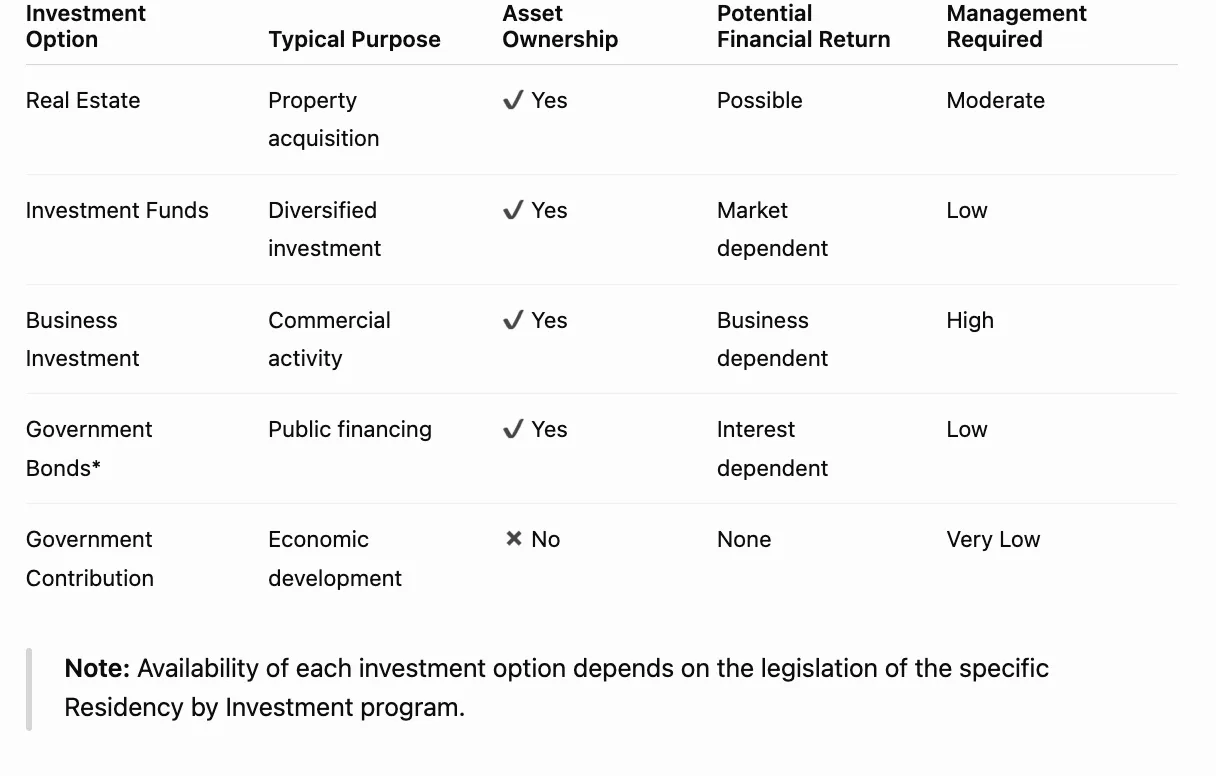
Qualifying Investment Options
Every Residency by Investment program requires applicants to make a qualifying investment, but the type, amount, and eligibility criteria vary significantly from one country to another. Some governments prioritize real estate development, while others encourage investment in businesses, regulated funds, or national economic initiatives.
Understanding the available investment options is essential because the right choice should align with your financial objectives, risk tolerance, liquidity preferences, and long-term plans—not simply the minimum investment threshold.
Below are the most common investment routes offered by Residency by Investment programs.
1. Real Estate Investment
Real estate remains one of the most recognized pathways for obtaining Residency by Investment. In countries where this option is available, applicants purchase qualifying residential, commercial, or mixed-use property that meets the program's minimum investment requirements.
Many investors prefer this option because it combines immigration benefits with ownership of a tangible asset.
Potential Advantages
Ownership of physical property.
Opportunity for rental income (subject to local laws).
Potential long-term capital appreciation.
Diversification into international real estate markets.
Considerations
Property values may fluctuate.
Maintenance and management costs.
Holding period requirements.
Local taxes and transaction fees.
Applicants should always verify that the property qualifies under the relevant program before making a purchase.
2. Investment Funds
Several countries allow applicants to qualify through investments in government-approved or regulated investment funds.
Rather than purchasing property, investors allocate capital to professionally managed funds that invest in sectors such as infrastructure, innovation, healthcare, technology, or sustainable development.
Potential Advantages
Professionally managed investments.
Portfolio diversification.
Reduced responsibility for asset management.
Exposure to multiple sectors.
Considerations
Market performance may vary.
Investment values can rise or fall.
Liquidity restrictions may apply.
Minimum holding periods often apply.
Investment funds may appeal to applicants seeking a more diversified investment strategy than direct property ownership.
3. Business Investment
Some Residency by Investment programs encourage applicants to establish or invest in businesses that contribute to the local economy.
Depending on the country's legislation, this may involve:
Launching a new company.
Expanding an existing international business.
Investing in approved commercial enterprises.
Creating employment opportunities.
Potential Advantages
Direct involvement in business activities.
Contribution to local economic development.
Potential commercial growth opportunities.
Expansion into new international markets.
Considerations
Business risk.
Regulatory compliance.
Ongoing operational responsibilities.
Market competition.
This option is often well suited to entrepreneurs and business owners planning long-term international expansion.
4. Government Bonds or Public Investment Instruments
Some jurisdictions have historically accepted investments in government bonds or similar public financial instruments as qualifying investments.
These options generally support national development projects while providing applicants with an investment-based route to residency.
Availability varies considerably and applicants should confirm whether such options remain active under the current legislation of each country.
5. Government Contributions
In certain jurisdictions, applicants may qualify by making a non-refundable contribution to a government-approved development or national investment fund.
Unlike property or fund investments, these contributions do not create ownership of an asset but are directed toward public development priorities.
Potential Advantages
Simpler application structure.
No property management responsibilities.
Often lower administrative complexity.
Considerations
Contribution is generally non-refundable.
No ownership interest is acquired.
Long-term financial returns are not expected.
Applicants should carefully compare this option with asset-based investments before making a decision.
Comparing Investment Options
Expert Insight
The best investment option is not necessarily the one with the lowest entry requirement. Consider factors such as liquidity, long-term financial objectives, investment horizon, personal involvement, and how the investment complements your broader wealth management strategy.
Eligibility Requirements
Although eligibility criteria differ between countries, most Residency by Investment programs require applicants to demonstrate that they meet certain legal, financial, and character requirements.
Common requirements include:
Valid passport.
Minimum age requirement (typically 18 years or older).
Clean criminal record.
Lawfully obtained investment funds.
Qualifying investment.
Health insurance where required.
Proof of financial capacity.
Supporting civil documentation.
Additional requirements may apply depending on the jurisdiction and the selected investment option.
Documents Commonly Required
Applicants are generally asked to submit documentation that verifies their identity, financial standing, and eligibility.
Typical documentation includes:
Passport copies.
Birth certificates.
Marriage certificate (if applicable).
Police clearance certificates.
Bank statements.
Proof of source of funds.
Investment documentation.
Medical insurance evidence (where required).
Passport-sized photographs.
Completed application forms.
Documents issued outside the destination country may need to be translated, notarized, or legalized according to local regulations.
Application Process
While every country follows its own legal framework, the Residency by Investment process generally follows a similar sequence.
Step 1 — Select a Country
Evaluate programs based on your goals, budget, family needs, and long-term plans.
↓
Step 2 — Choose a Qualifying Investment
Select the investment route that best aligns with your objectives and satisfies the program's requirements.
↓
Step 3 — Prepare Documentation
Gather identity, financial, and supporting documents.
↓
Step 4 — Submit Your Application
Submit the application through the designated government authority or authorized channel, together with the required documentation and applicable fees.
↓
Step 5 — Due Diligence
Authorities verify identity, background, and compliance with program requirements.
↓
Step 6 — Approval
Once all legal requirements have been satisfied, the application may be approved.
↓
Step 7 — Complete the Investment
Where required, finalize the qualifying investment within the prescribed timeframe.
↓
Step 8 — Receive Your Residence Permit
The applicant and approved dependants receive their residence permits in accordance with the program's rules.
How Long Does the Process Take?
Processing times vary considerably depending on the country, the complexity of the application, and the due diligence process.
Factors that can influence timelines include:
Completeness of documentation.
Government processing capacity.
Due diligence requirements.
Investment verification.
Family size.
Additional information requests.
Rather than focusing solely on speed, applicants should prioritize choosing a program that aligns with their long-term objectives and offers a clear legal framework.
Common Mistakes to Avoid
Many applicants concentrate only on the advertised investment amount, overlooking other important considerations.
Avoid these common mistakes:
Choosing a program based only on the lowest investment threshold.
Failing to understand residency obligations.
Assuming every Golden Visa offers the same rights and benefits.
Ignoring tax implications.
Overlooking renewal requirements.
Investing before confirming eligibility.
Not verifying whether an investment qualifies under the program.
Focusing only on approval speed instead of long-term suitability.
Expert Insight
A successful Residency by Investment strategy balances immigration objectives with sound financial planning. The most effective applicants compare legal requirements, investment characteristics, family benefits, and long-term residency pathways before making any investment decision.
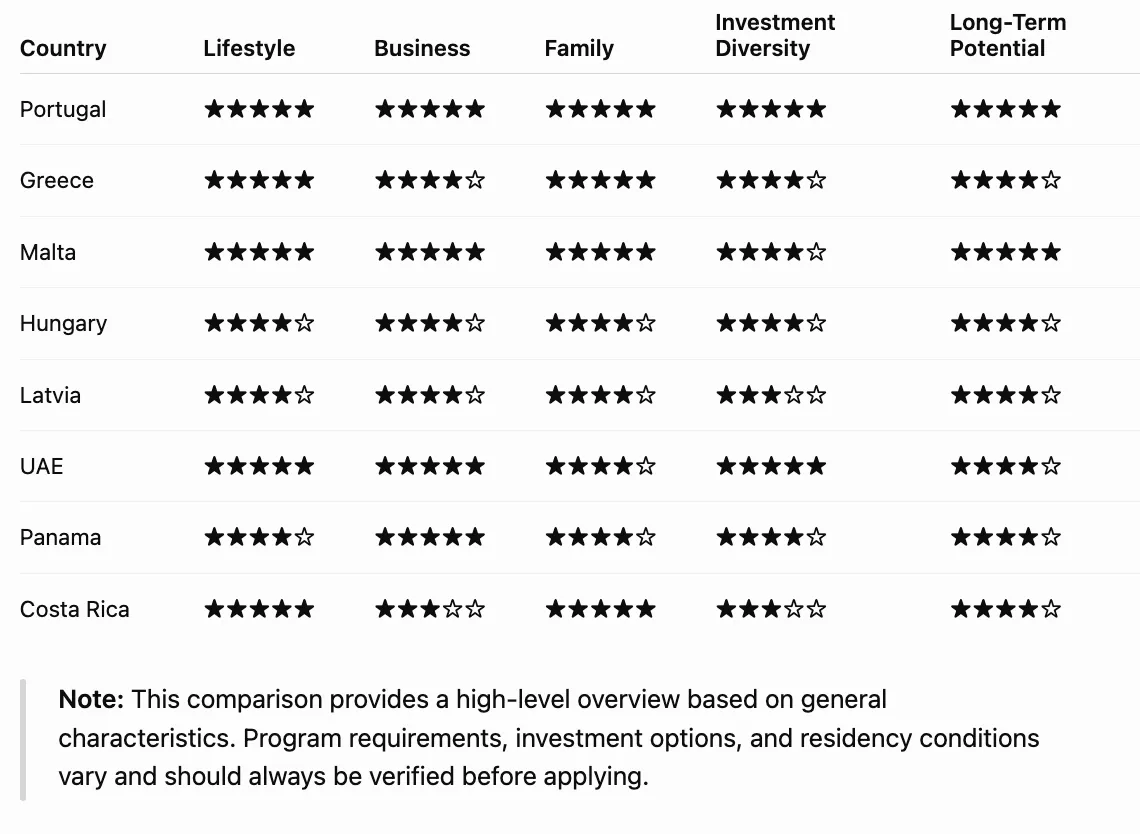
Best Residency by Investment Destinations
Choosing the right Residency by Investment destination involves much more than comparing minimum investment amounts. Every country offers a unique combination of legal rights, residency obligations, lifestyle advantages, tax considerations, business opportunities, and long-term pathways.
Rather than asking, "Which country is the best?", the better question is:
"Which Residency by Investment program best supports my personal, family, and financial goals?"
Below is an overview of some of the world's most recognized Residency by Investment destinations.
Portugal
Portugal has long been one of Europe's most popular destinations for international investors due to its high quality of life, strategic location, and established residency framework.
Many applicants choose Portugal because of its:
Strong international reputation
Excellent healthcare system
High-quality education
Stable economy
Attractive lifestyle
Long-term residency opportunities
Best suited for:
Families
Entrepreneurs
Long-term European relocation
Investors seeking lifestyle benefits
Greece
Greece offers one of Europe's most recognized Residency by Investment programs and continues to attract applicants seeking Mediterranean living combined with access to European markets.
Popular reasons include:
Mediterranean lifestyle
International connectivity
Growing property market
Family-friendly environment
Access to Europe
Best suited for:
Property investors
Families
Lifestyle-focused applicants
Malta
Malta combines a strategic Mediterranean location with a well-developed financial sector and English-speaking environment.
Applicants often value Malta for:
International business environment
Education
Healthcare
Stable legal framework
Long-term residency opportunities
Best suited for:
Business owners
Families
International professionals
Hungary
Hungary has reintroduced an investment-based residency pathway aimed at attracting international investors.
Advantages include:
Central European location
Growing economy
Competitive investment environment
Access to European markets
Best suited for:
Investors
Entrepreneurs
Individuals seeking a European base
Latvia
Latvia offers residency opportunities through qualifying investments and is often considered by applicants looking for access to Northern and Eastern European markets.
Highlights include:
Strategic Baltic location
Business opportunities
Competitive living costs
International connectivity
United Arab Emirates
The UAE has become one of the world's leading destinations for entrepreneurs, investors, and internationally mobile professionals.
Applicants often choose the UAE because of:
Global business hub
Modern infrastructure
High quality of life
Strong aviation connectivity
Dynamic economy
Best suited for:
Entrepreneurs
Investors
International executives
Panama
Panama has long been recognized as an attractive destination for international business and residency planning.
Advantages include:
International banking
Strategic geographic location
Business-friendly environment
Regional connectivity
Costa Rica
Costa Rica appeals to applicants seeking a relaxed lifestyle supported by natural beauty and political stability.
Reasons applicants choose Costa Rica include:
Lifestyle
Retirement planning
Nature
Stable democracy
Quality of life
Residency by Investment Country Comparison
Why Compare Before You Apply?
Comparing programs helps you make informed decisions instead of relying on marketing claims or headline investment amounts.
Important comparison factors include:
Investment options
Processing timelines
Family eligibility
Residency obligations
Renewal requirements
Business opportunities
Education
Healthcare
Long-term residency rights
Citizenship pathways
A structured comparison makes it easier to identify the program that best supports your objectives.
How Zenvify Helps You
Choosing a Residency by Investment program can be complex, especially when comparing multiple countries and legal frameworks.
Zenvify simplifies this process by providing:
Compare Residency by Investment Programs
Evaluate countries side by side based on investment options, eligibility, family inclusion, processing timelines, and long-term opportunities.
Explore Country Guides
Access detailed guides covering:
Eligibility requirements
Investment options
Application process
Benefits
Residency obligations
Family inclusion
Costs
Timelines
Generate a Personalized Immigration Roadmap
Every applicant has different priorities.
Generate a customized roadmap based on your:
Goals
Budget
Family situation
Preferred destination
Investment preferences
Long-term plans
Make Better Decisions
Instead of comparing programs manually across multiple websites, use Zenvify's educational resources and comparison tools to make informed decisions with confidence.
Final Thoughts
Residency by Investment has become one of the most effective pathways for individuals seeking greater international flexibility, family security, and long-term opportunities. Whether your objective is expanding a business, improving access to education and healthcare, planning for retirement, or creating a pathway toward permanent residency or citizenship, selecting the right program requires careful consideration.
Every Residency by Investment program is different. Investment options, eligibility requirements, residency obligations, renewal conditions, and long-term pathways vary between countries. Taking the time to understand these differences and compare programs objectively will help you make a decision that supports both your immediate needs and your future aspirations.
Rather than focusing solely on investment thresholds or processing times, evaluate each program based on how well it aligns with your personal goals, financial strategy, family priorities, and desired lifestyle. A well-informed decision today can create valuable opportunities for years to come.
Ready to Explore Residency by Investment?
Take the next step with Zenvify.
Compare Residency by Investment Programs
Evaluate countries side by side to identify the program that best matches your goals.
Generate Your Personalized Immigration Roadmap
Receive a customized roadmap tailored to your budget, objectives, and preferred destination.
Explore Country Guides
Learn more about individual Residency by Investment programs, investment options, eligibility requirements, and application processes before making your decision.
Ready to explore your options?
Book a Free Consultation